This article was originally published by Votebeat, a nonprofit news organization covering local election administration and voting access.
Carter Walker, Votebeat
Votebeat is a nonprofit news organization reporting on voting access and election administration across the U.S. Sign up for Votebeat Pennsylvania’s free newsletter here.
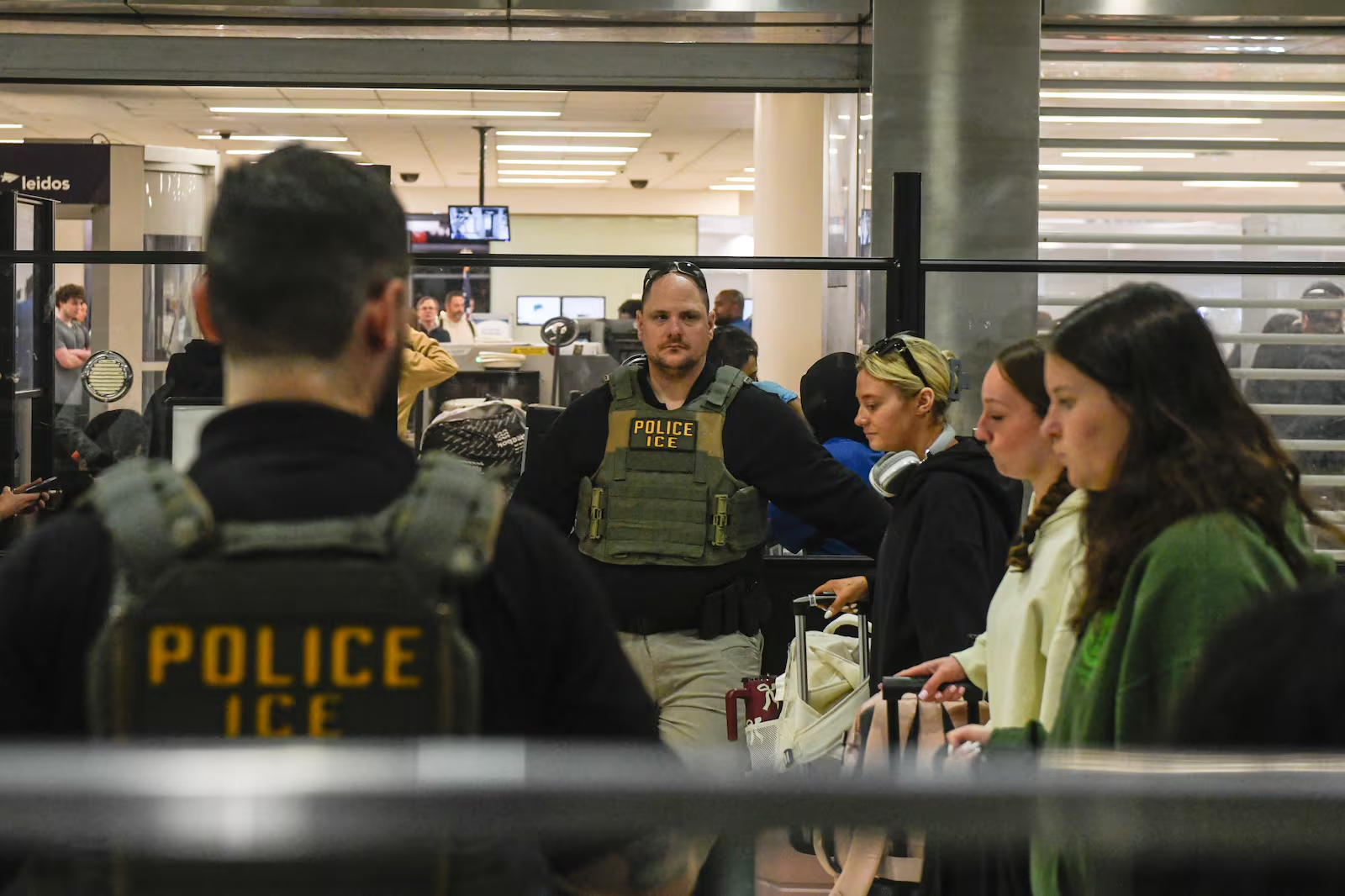
As the 2026 midterms near, one question repeatedly comes up in discussions about potential disruptions to election administration.
“‘What if ICE shows up?’ That’s what I’m hearing,” Olivia Hale, the election director in San Joaquin County, California, said on a recent call sponsored by the Partnership for Large Election Jurisdictions.
Federal law already prohibits stationing “troops or armed men at any place where a general or special election is held,” along with other voting protections. But Hale isn’t the only one raising concerns. In Pennsylvania, state Rep. Malcolm Kenyatta (D-Philadelphia) says he’s trying to respond by clarifying state law.
Pennsylvania’s election code already prohibits police from being within 100 feet of polling places. Kenyatta has introduced a bill that would expand the language to include federal agents as well.
Currently, the law says “no police officer … shall be within one hundred feet of a polling place” on Election Day. Kenyatta’s proposal would replace “police officer” with the more expansive term “law enforcement officer.”
The prospect of passing any election legislation before the November election is slim — as it has yet to receive a vote in the state House — but Kenyatta says it is important to do so.
“We have become so accustomed to the president blatantly lying about the election, threatening people, using the court process and administrative powers granted to him to try to intimidate voters,” he said. “So there is in my view a real necessity to clarify the law.”
President Donald Trump’s administration hasn’t articulated any specific plans to send ICE to the polls this year.
But the administration’s messaging has been inconsistent on this issue. In February, in response to former Trump advisor Steve Bannon’s comment that “we’re going to have ICE surround the polls,” former White House spokesperson Karoline Leavitt said she “can’t guarantee” there wouldn’t be ICE agents around the polls in November.
Later that month, however, Heather Honey, a Department of Homeland Security official, told a group of state election officials that any such suggestion was “disinformation” and that “there will be no ICE presence at polling locations for this election.”
In July, Attorney General Todd Blanche didn’t rule out the possibility. In September the Department of Homeland Security said it was not “planning” ICE operations targeting polling places but might conduct “targeted enforcement” actions if there is a public safety threat at a polling location.
In response to a request for comment, a spokesperson for the department reiterated it is not planning any operations targeting polling places. They referred Votebeat and Spotlight PA to remarks from Secretary Markwayne Mullin’s confirmation hearing in March.
“I don’t understand what the concern is about enforcement of immigration at polling places anyways, because honestly if you’re not a citizen, you shouldn’t be voting anyways, so technically there shouldn’t be illegals at the polling spot,” he said. “The only reason why my officers would be there is if there was a specific threat for them to be there, not for intimidation.”
The concern that ICE may come to polling places prompted a coalition of civil rights groups and the City of Denver to sue the Trump administration last month to stop any such action. A similar but separate lawsuit was also filed recently by the NAACP and a coalition of civil rights groups and unions.
Voting rights groups are worried in Pennsylvania as well.
“There are some concerns that immigrant communities or underserved communities have that there could be ICE at the polls,” said Kadida Kenner, CEO of the New Pennsylvania Project. “I think there has been so much chaos at this moment … that I think all of us want to be clear on what the rules are.”
Jasmine Rivera, the executive director of the Pennsylvania Immigrant Coalition, said that increased immigration enforcement under the Trump administration has had a chilling effect on immigrants of all statuses in all aspects of life, not just elections. One in 12 people living in Pennsylvania is an immigrant, Rivera said, and 53% of them are naturalized citizens.
“For all of us in the immigrant rights space, we know that [having ICE at the polls] is a possibility on the table,” she said, although she stressed that it’s not guaranteed either. “It’s better to be safe than sorry.”
She said her coalition is urging eligible immigrant voters to vote by mail “to make sure the vote gets out, but also to keep people safe.”
Jonathan Diaz, the director of voting advocacy and partnerships at the Campaign Legal Center, noted that federal law provides protections beyond the ban on armed troops at polling places.
“Similar federal statutes prevent civilian federal employees from using their official position to influence federal elections,” he said. “There are also federal statutes that make it a crime to intimidate or attempt to intimidate voters in federal elections.”
Deborah Hinchey, the Pennsylvania state director for All Voting is Local, said efforts by “bad faith actors” to discourage in-person voting have not been successful. Her impression is that voters still understand voting is safe and important, particularly in Pennsylvania.
Polls support that contention. A survey this month from Harvard University’s Shorenstein Center found that only 6% of people selected immigration enforcement at the polls as their biggest concern about the election, though Democrats were the most concerned.
But, Hinchey said, Kenyatta’s bill is still worth considering.
“I do think the concern that law enforcement could be at the polling locations is something that we should address legislatively if possible,” she said. “I think the current political moment we are in somewhat requires us to be more prescriptive and be more descriptive about what that means.”
Kenyatta said his bill is intended to block all law enforcement officers, including ICE agents, and prevent any issues their presence at the polls might cause. He pointed to Wyoming’s Republican governor recently complaining about Department of Justice election monitors being “a bit aggressive” during the state’s August primary election. (However, it’s unclear whether the proposed law would apply to those monitors, who have monitored state elections for years without incident and are not generally considered law enforcement.)
“What we must do, in my view, is clarify that in no uncertain terms, that even though the language speaks broadly about law enforcement, about police, we also meant you,” he said. “Sometimes even when we think the law is pretty clear, you have people who don’t read it with the same clarity.”
Votebeat Arizona reporter Sasha Hupka contributed reporting.
Carter Walker is a reporter for Votebeat in partnership with Spotlight PA. Contact Carter at cwalker@votebeat.org.
Votebeat is a nonprofit news organization covering local election integrity and voting access. Sign up for their newsletters here.